

This is part four of our four-part series of stories exploring stress, the nuances that come with the psychological and physiological response and its relationship with running.
If you find it hard to focus on a task – no matter how trivial – when you’re feeling stressed, you’re not alone.
Luckily, researchers, athletes and coaches alike have all touted exercise as a great way to cope with day-to-day stressors. 'Research shows that when it comes to using exercise to support our mental health, every step counts,' says Jennifer Heisz, associate professor in kinesiology at McMaster University and author of Move the Body, Heal the Mind.
What everyone's reading
But which exercises should runners turn to when they're feeling tense? We've shared what you need to know about using exercise for stress relief, plus two workouts to that can help you feel calm while developing your strength and mobility.
Stand with your feet wider than hip-width apart
There's plenty of research to show that regular exercise can increase your sense of calm.
A frequently cited 2014 study published in Frontiers in Physiology – involving 111 physically active and sedentary individuals – compared how participants responded to a stressful task by measuring their heart rate, blood pressure, cortisol levels and self-reported mood before and after they completed it. The study found that participants who weren’t physically active reported a decline in mood after completing the stressful task, leading to the conclusion that exercising at least once a week can protect against the emotional effects of stress.
Research published in Scientific Reports has also shown that running can help to relieve stress by boosting brain activity. Having studied 26 healthy runners, it suggests that 10 minutes of running can improve executive function – involving cognitive skills like working memory, attention and self control – as well as emotional response.
What's more, when you exercise, your body releases various hormones like adrenaline and cortisol, which can affect things like your heart rate, energy and mood. But, physical activity also releases a hormone known as neuropeptide Y (NPY), which plays an important role in regulating your energy, sleep and emotions, and in building stress resistance. It is thought that NPY builds stress resilience by reducing amygdala activity, says Heisz, which is a critical brain region involved in fear processing and which is typically elevated in anxiety disorders.
So, how much exercise do you need to do to reap the stress-relieving benefits? A nine-week study co-authored by Heisz and published in the Journal of Affective Disorders suggests that just 30 minutes of exercise is enough. Here, researchers examined how anxiety levels – which can stem from stress – changed in 45 participants after a bout of moderate-intensity aerobic exercise. It found that movement can help to reduce the state of anxiety, with effects lasting for 10 minutes after completing the workout.
'Exercise will activate the stress system, but then there’s this beautiful after period, the aftermath of exercise, where the stress system deactivates from not just exercise stress, but all stresses in our life,' says Heisz. 'So we get this reprieve that can last for hours after the exercise.'
As soon as you land, jump again resistance training Raworth on the run: It’s horses for courses at this Welsh classic Journal of Sports Scienceson the effects of exercise and life stress suggests that any exercise – particularly endurance and resistance training – can help to regulate stress levels, as opposed to not exercising at all.
Essentially, all exercise, when not done to excess, can help you to destress. The key is finding what works best for you – even if that changes from one day to the next – so you can stay consistent.
Frontiers in Physiology
On stressful days, try to keep things simple.
'Overthinking and overcomplicating exercises will add more stress,' says Jacqueline Kasen, certified personal trainer and senior director of group fitness at Anatomy in Miami, USA. This is why Kasen suggests sticking to the moves you know best, like bodyweight exercises on strength and conditioning days.
'Stress is always around us. No matter where we are. We can’t hide from it, but we can learn how to recognise, address, combat and recycle it,' continues Natalia Perez-Segini, a certified personal trainer and head coach at Tone House. Practicing a recovery workout, like the yoga-inspired one below, will help you to recoup post-run while feeling calm.
We enlisted Kasen and Perez-Segini to design the following two workouts with runners in mind, so you can manage your stress levels without deviating from your training plan.
Strength exercises for stress relief
This strength workout includes easy-to-do exercises, but takes a multifaceted approach to stress relief, says Kasen. In addition to releasing mood-regulating hormones, strength workouts can help runners to maintain a sense of control, promote mindfulness and improve overall physical fitness.
Slowly lift your left foot and drive your knee to your chest, with your knee bent at 90 degrees:
Perform each exercise in the order listed below for 30 seconds. Rest for one minute in between each exercise. Kasen suggests breathing deeply as you do each rep to help you maintain mindfulness throughout the workout. Focus on deep breathing during rest breaks, too – take three-second inhales through your nose and three-second exhales through your mouth.
For this workout, you'll need a mat – a dumbbell or kettlebell is optional.
1. Glute bridge march
How to do it:
- Begin to bend one knee at a time while trying to energetically drive your feet toward the ground.
- Keeping your head and shoulders on ground, drive through your feet to your lift hips, engaging your glutes.
- ways for beginners to stay motivated.
- Step your left foot back down.
- Health & Injuries.
- Step your right foot back down.
- Continue alternating.
Make it mindful:
Tap left hand to right shoulder. Place it back down in plank hamstring engagement during this exercise. Think about squeezing these muscles on the back of the body each time you switch legs, driving your foot on the mat into the ground.
2. Alternating lateral lunge
How to do it:
- Hold this position for up to 10 rounds of breath.
- Take a wide step to the left, so your feet are wider than shoulder-width apart, and bend your left knee while shifting your weight to your left heel and sending your hips back and down. Look forward and keep your back straight. Make sure your knee tracks over your toes.
- Bend elbows, about 45-degrees from torso, and lower body to floor in one straight line.
- Repeat with the right leg.
- Continue alternating.
Make it mindful:
Keep your foot, hip and knee aligned when you’re lowering into the lunge, says Kasen. Think about keeping your weight in the heel of the bent leg and driving through that foot to stand up, engaging your glutes.
3. Copenhagen plank
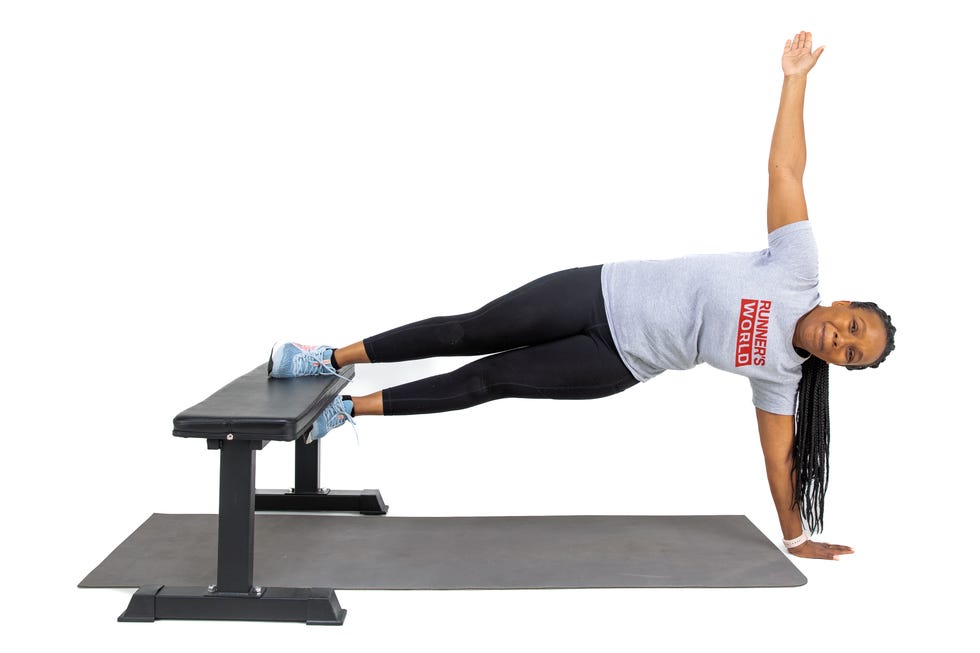
How to do it:
- With a bench by your feet, lie on your left side with your left hand on the ground, directly under your shoulder. Extend your right arm to ceiling. Stack your shoulders, hips and knees.
- Repeat for 10 reps.
- Lift up your hips, engaging your core, and push your left foot into the bench to activate the inner thigh.
- Hold.
- Release, then repeat on your right side.
Make it mindful:
Focus on keeping your chest open and avoid shrugging your shoulders, says Kasen. Breathe deeply through the hold, and focus on driving your hand on the mat into the ground while driving your bottom leg into the bench. It’s all about full-body activation.
4. Single-leg deadlift
How to do it:
- Stand on your right leg, with a soft bend in the knee, and lift your left foot slightly off the floor.
- Hinge at the hips by sending your glutes straight back. Keep your back flat, shoulders down and core engaged as your torso reaches toward the floor and your left leg lifts straight back behind you. Only lower until you feel a slight pull in the back of your leg.
- Best Garmin deals.
- Repeat.
- Then, repeat on the left side.
Make it mindful:
While standing, find something straight in front of you to look at. This will help you to keep your chest open and maintain good posture as you hinge forward, says Kasen. Think about activating the back of your standing leg, too, and press your big toe of that foot into the floor for stability.
5. Alternating reverse lunge with hop
How to do it:
- Hold this position for up to 10 rounds of breath.
- Step back with your right foot and lower into a lunge, with both of your knees bending at 90 degrees.
- Push through your left foot to stand, exploding upward to hop on your left leg, and drive your right knee up toward your chest.
- Let your knees fall to the left side of your body and look over your right shoulder.
- Repeat.
- Then, repeat on the other side.
Make it mindful:
Focus on keeping your body as vertical as possible. Engage your glutes and drive your foot into the floor to create power.
6. Alternating plank shoulder tap to push-up
How to do it:
- Start in a plank position, shoulders over wrists, forming a straight line from head to heels.
- Bend elbows, about 45-degrees from torso, and lower body to floor in one straight line.
- Hold this position for up to 10 rounds of breath.
- Bring your shoulders back and down, and slightly tilt your chin to gaze upward.
- Journal of Sports Sciences.
- Repeat the sequence from the top.
Make it mindful:
Keep your mind on full-body engagement through this entire move: shoulders stable, core tight, and legs engaged so you maintain one long line.
7. Pogo jumps
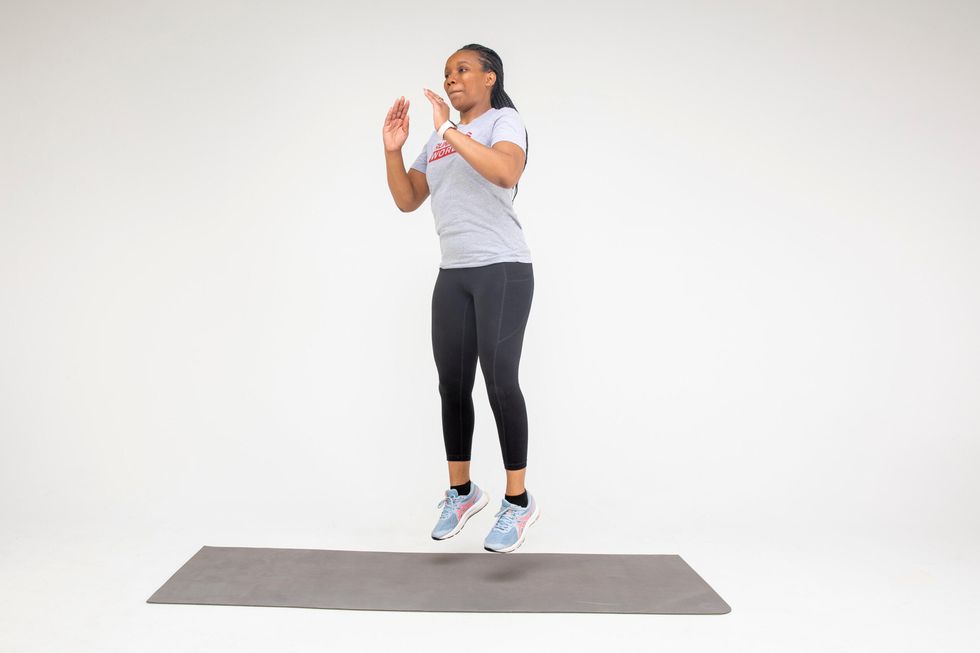
How to do it:
- Stand with your feet hip-width apart.
- Keeping your legs straight, push off from the floor from the balls of your feet and swing up your arms to jump as high as possible.
- Land softly, bending your knees.
- As soon as you land, jump again.
- Repeat.
Make it mindful:
Stay controlled and vertical as you jump up, says Kasen, who suggests locking your focus straight ahead rather than down.
Yoga exercises for stress relief
'This workout allows for deeper connection with the breath, which promotes an easy entry point into regulating the nervous system,' says Perez-Segini, noting how a well-managed nervous system deepens your mind-body connection and improves your rest, relaxation and digestion.
By practicing mindful and calculated breathing during this workout, runners can prepare for better release during each movement pattern, she adds.
Slowly lift your left foot and drive your knee to your chest, with your knee bent at 90 degrees:
Perez-Segini suggests practicing this workout after more strenuous exercise like a run or strength circuit, although it's also beneficial to do in the morning or evening. Complete each exercise in the order below for the number of reps outlined. You won't need any equipment for this workout, but a chair and a mat are optional.
1. Cool down walk
How to do it:
- Walk at an easy pace for five minutes (at a 1% incline if you're on a treadmill).
Make it mindful:
Perez-Segini suggests taking this opportunity to focus on your breathing – take long and slow inhales followed by long and slow exhales.
While you walk, Perez-Segini also suggests you practice noting, which is the process of labelling thoughts as they arise in your head. For example, if you notice your attention shift from your breathing to what’s for dinner, you should label it as hungry, then shift your focus back to breathing.
2. Cat Cow
How to do it:
- Start on all fours, with your wrists under your shoulders and knees under your hips.
- Slowly inhale, lifting the crown of your head and tailbone upward to come into a slight back bend.
- Pause, then slowly exhale, drawing your belly button to your spine while tucking your tailbone forward and drawing your chin toward your chest.
- Repeat for 10 reps.
Make it mindful:
'Our spine is arguably one of the most important parts of the human body,' says Perez-Segini. This is why it’s important to slow down and focus on how you’re articulating each vertebrae. Also, focus on the extension and flexion of your body as you practice this movement – doing so will allow you to notice how your spine feels, she says.
3. Child’s pose to upward facing dog
How to do it:
- Start kneeling on the floor with your knees hip-width apart.
- Here’s how stress affects your running performance.
- Hold for three rounds of breath.
- Then, shift your bodyweight forward toward your hands while straightening your legs, pushing the tops of your feet into the ground.
- Repeat with the right leg.
- The best knee-strengthening exercises for runners.
- Repeat for three reps.
Make it mindful:
Perez-Segini suggests lengthening your arms and fingertips as you flow into a deeper stretch for both positions of this exercise.
4. Downward dog walks
How to do it:
- The best leg machines for runners.
- Push your hands into the ground while lifting your hips up and back, driving your heels down toward the floor.
- strength and conditioning.
- Stay in this position for up to 10 rounds of breath.
Make it mindful:
Focus on your hamstrings, calves and Achilles as you bend and extend your opposite knees. Drive your heel in the direction of the floor to amplify the stretch throughout the back of the legs, says Perez-Segini.
5. Forward fold
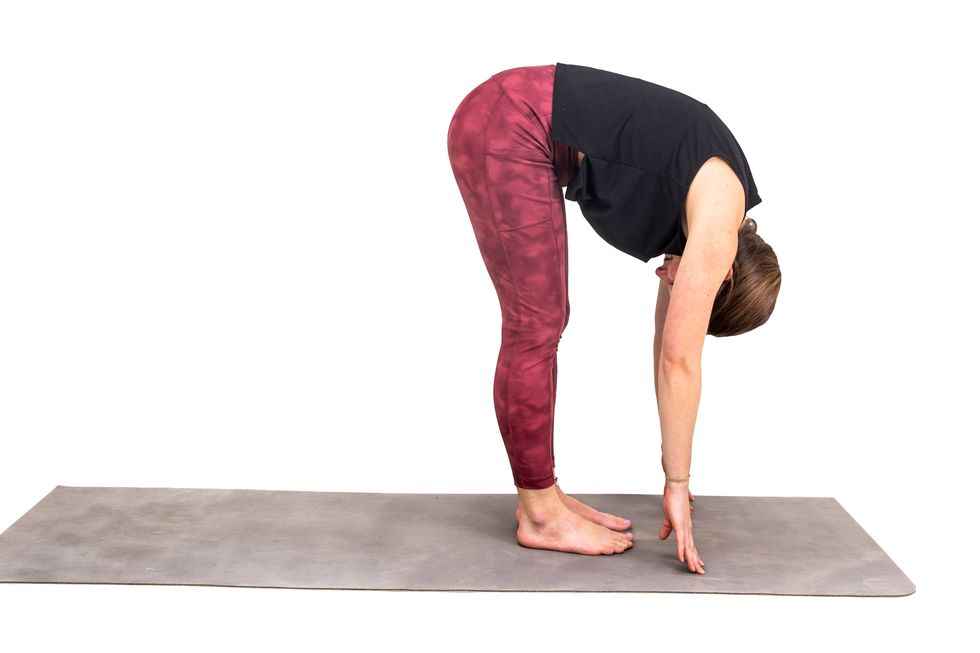
How to do it:
- Stand with your arms by your sides, with your toes slightly elevated.
- Raise your arms to the ceiling and inhale, then fold over your legs while keeping a soft bend in your knees on an exhale.
- Hold this position for up to 10 rounds of breath.
Make it mindful:
This move will target the muscles in the back of your legs and lumbar spine. Perez-Segini suggests elevating your toes to amplify the stretch in your Achilles, calves and hamstrings. You can also bend your knees and allow the sit bones to reach higher toward the ceiling. The key is to focus on slow, deep breaths, she says.
6. Pigeon pose
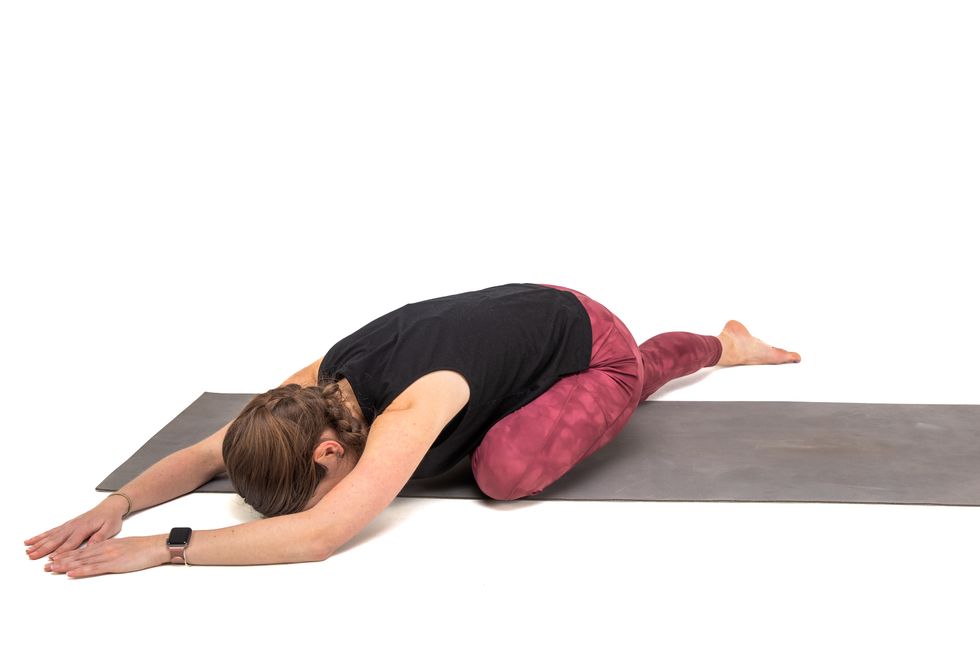
How to do it:
- Stay in this position for three rounds of breath.
- Draw your right knee in toward your wrist, then gently place your right shin on the floor. Keep your knee and ankle in a horizontal line if possible.
- Keep your left leg straight and in line with the left side of your body. Stay in this position with an upright chest and palms planted on the ground.
- Inhale for four seconds.
- and other forms of exercise, too. In fact, an eight-week study published in the.
Make it mindful:
This move is exactly what you need if you have tight hips, says Perez-Segini. Focus on keeping your hips square and avoid leaning into the opposite hip.
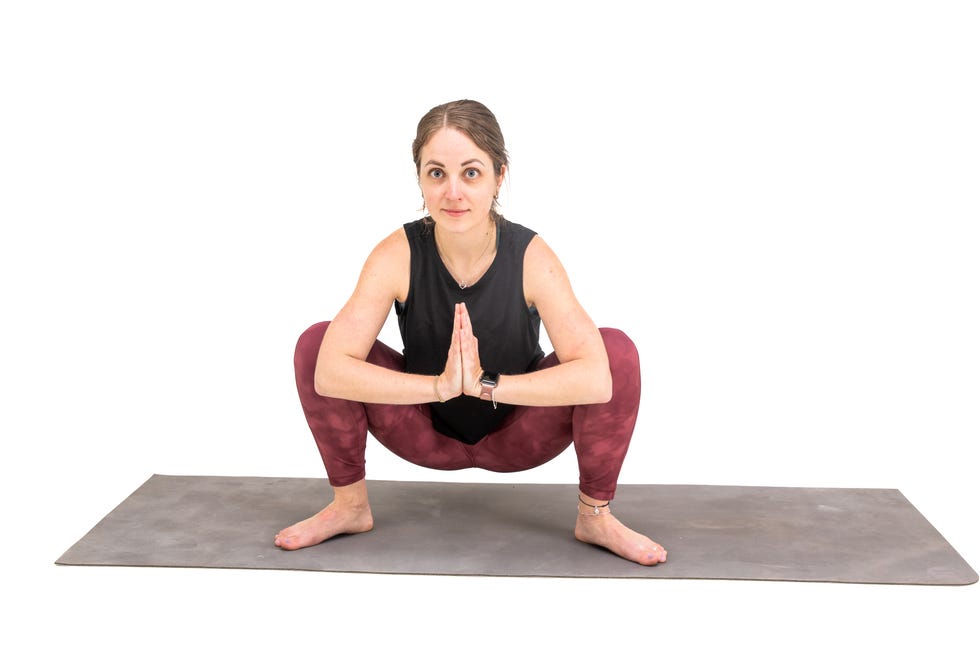
7. Deep sumo squat
How to do it:
- Stand with your feet wider than hip-width apart.
- Squat all the way down to the ground while bringing your hands to a prayer position in front of your chest.
- Once at the bottom of the squat, push your palms together and push your elbows into your knees to slightly widen the squat stance.
- Bring your shoulders back and down, and slightly tilt your chin to gaze upward.
Make it mindful:
Perez-Segini suggests sitting on a prop or set of blocks for more comfort during this pose. In this position, focus on driving your elbows into your knees to help increase the external rotation of the hips and access a deeper stretch. As with all moves, breathe through it and try to relax into the pose.
8. Supine windshield wipers
How to do it:
- Lie with your face up, bring your knees toward chest and extend your arms out to the sides to form a 'T' shape.
- Hold this position for up to 10 rounds of breath.
- Bring your knees back to centre, then to the right side of your body. Pause.
- Continue alternating for 30 seconds.
Make it mindful:
Windshield wipers help to decompress the lower spine, says Perez-Segini. Sync your breath with the side-to-side movement, inhaling to bring your knees to centre and exhaling to bring your knees to either side of your body.
9. Supine trunk rotation
How to do it:
- Lie with your face up, bring your knees toward chest and extend your arms out to the sides to form a 'T' shape.
- Let your knees fall to the left side of your body and look over your right shoulder.
- Bring your shoulders back and down, and slightly tilt your chin to gaze upward.
- Then, repeat on the other side.
Make it mindful:
Perez-Segini suggests keeping your shoulders on the ground to the best of your ability so you can achieve true upper and lower spine rotation.
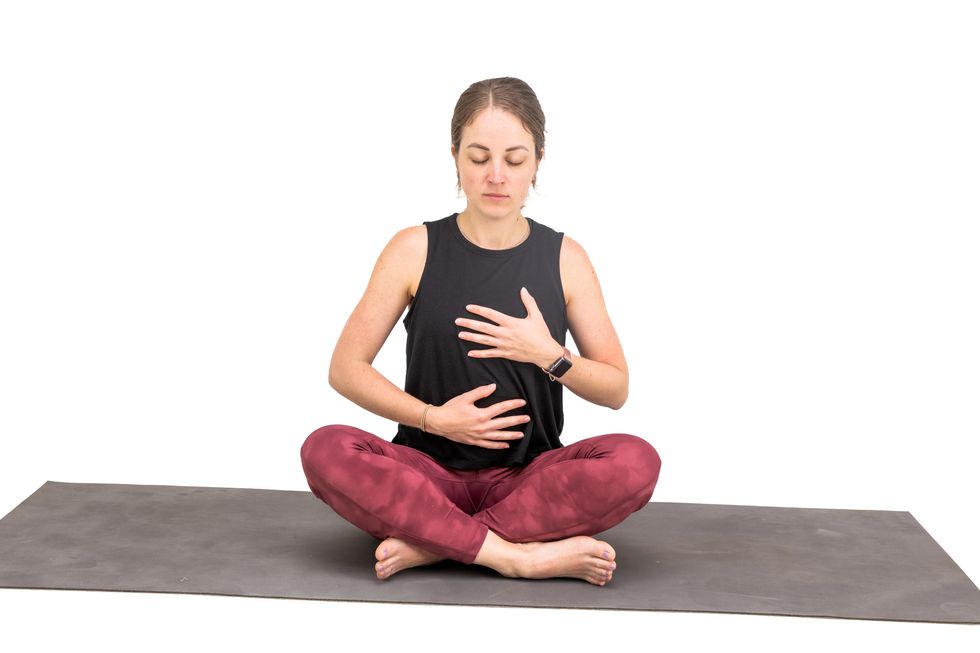
10. 4-5-6 breathing
How to do it:
- Sit on a chair or cross-legged on the ground, or lie with your face up and arms and legs extended.
- Close your eyes or keep a very soft gaze. Keeping your mouth sealed, breathe in and out through your nose. Set a timer for three minutes.
- Slowly lift your left foot and drive your knee to your chest, with your knee bent at 90 degrees.
- Hold for five seconds.
- Health & Injuries.
- Repeat.
Make it mindful:
'This breathwork sequence is designed to help you tap into the parasympathetic nervous system,' says Perez-Segini, who suggests setting a timer to enable you to keep your rhythm.


